What is MMS? Learn how Managed Mobility Services streamline operations and support for diverse enterprise devices.s manage mobility across devices, plans, orders, support, and invoices without slowing employees down.
Summarize this article with:
What Are Managed Mobility Services? A Guide to Enterprise Mobility Management
Enterprise mobility is no longer limited to smartphones. Mobility management now encompasses laptops, rugged devices, point-of-sale systems, IoT devices, fixed wireless access, and other connected assets across carriers, locations, and users. With every device type comes a series of operational requirements, from procurement and configuration to deployment, support, expense management, recovery and retirement.
Managing mobility complexity becomes increasingly difficult as device fleets compound and business requirements change. Managed Mobility Services (MMS) provide the technology, processes, and specialized expertise organizations need to coordinate device management activities at enterprise scale. An MMS program helps teams drive control throughout their estate by maintaining visibility across their environment while establishing stronger governance and control throughout the device lifecycle.
What Are Managed Mobility Services?
At a Glance:
Managed Mobility Services (MMS) combine technology, operational processes, and specialized services to help organizations manage enterprise mobile devices, connectivity, expenses, and lifecycle activities.

The scope of MMS can be extensive depending on the size and needs of the mobile estate. Managed mobility services may include device sourcing and procurement support, configuration, kitting, carrier activation, deployment, inventory management, end-user support, repairs, logistics, mobile expense management, recovery, and retirement.
MMS activities can also connect with enterprise systems such as Unified Endpoint Management (UEM), IT service management (ITSM), HR, procurement, and ERP platforms. Rather than requiring internal teams to coordinate their estate independently, managed mobility creates a structured operating model for overseeing the mobility environment.
Managed Mobility Services in a nutshell:
A managed mobility solution brings greater consistency to this lifecycle and reduces the operational burden for internal teams. For large or distributed enterprises, efficiency becomes especially important as mobility operations extend across multiple carriers, device types, countries, vendors, and employee groups.
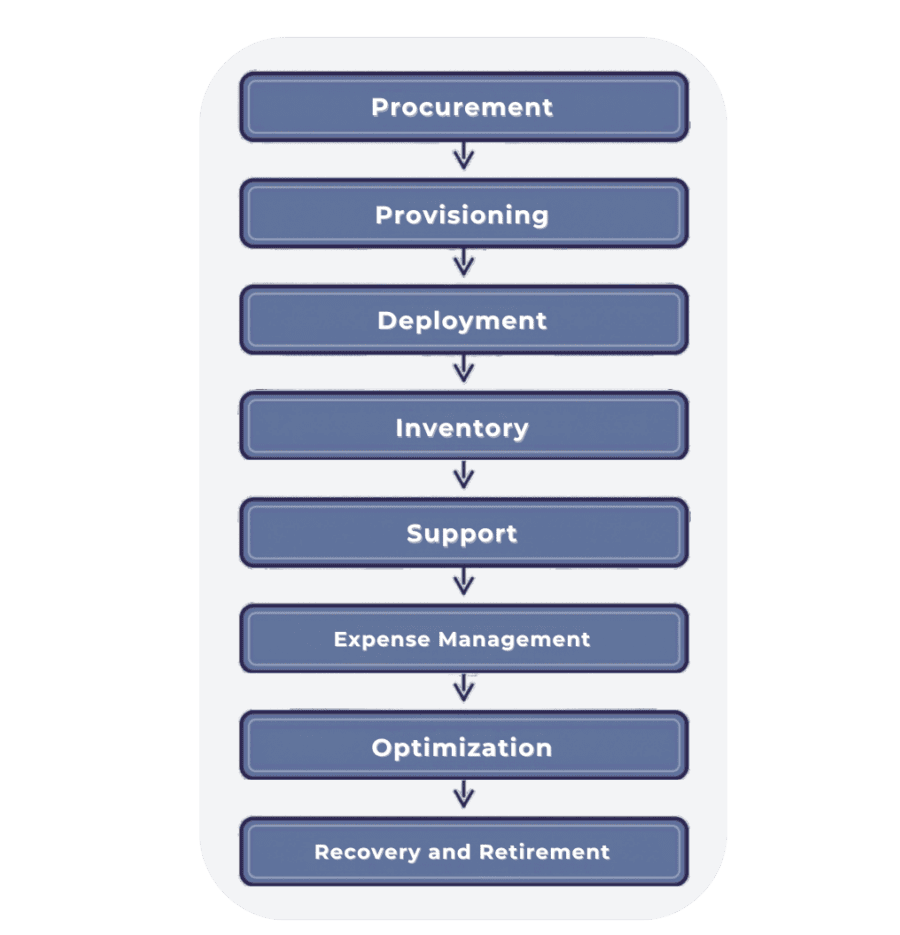
Organizations can use mobile managed services to support only some or all of these activities depending on their internal resources and mobility strategy. In either scenario, the goal remains consistent: create an operating model that makes enterprise mobility easier to manage, govern, optimize, and scale.
Why Is Enterprise Mobility Becoming Harder to Manage?
Managing mobile devices in the enterprise has become a much broader responsibility as the definition of mobility itself has expanded.
Employees may depend on a myriad of devices to support daily work: smartphones, laptops, rugged devices for fieldwork, point-of-sale systems for retail locations, and IoT or fixed wireless connectivity. As device types expand, so do the amount of carriers, vendors, and geographies, each with different procurement processes, rate structures, support requirements, and lifecycle expectations.
Operational complexity grows alongside the device estate as well. Where IT teams need accurate inventory records and standardized processes for ordering, configuration, deployment, repairs and replacement, Finance and Procurement need reliable information about wireless costs, contracts and vendors. Security teams require devices to be enrolled in the appropriate endpoint management systems and governed according to company policies. Employees, meanwhile, expect new devices, replacements, and support without lengthy delays.
Operational responsibilities often cross systems that were designed to solve different parts of the problem, such as UEM, HR, and ITSM tools. When those systems and processes operate independently, maintaining an authoritative view of mobility becomes formidable.
Global operations adds to the management challenge. Device availability, carriers, regulations, logistics and support requirements can vary considerably by geography, making a process that works in one country difficult to replicate elsewhere.
At a Glance:
Enterprise mobility management requires coordination across the systems, services, spend, and operational work surrounding every device. Managed mobility provides a framework for connecting those activities so organizations can manage mobility consistently as their device estates evolve.
What Does Managed Mobility Include?
The exact scope of managed mobility services varies by organization and provider, but a comprehensive program can support nearly every stage of the enterprise mobility lifecycle. The strongest programs connect all activities so that change in one part of the lifecycle is reflected across inventory, connectivity, support, and expense management.
Device Procurement and Provisioning
The mobility lifecycle begins before a device reaches an employee.
Procurement and provisioning can include device sourcing, approved catalogs, ordering, carrier selection, service activation, and configuration. Organizations may also need devices staged and kitted with accessories, applications, or other requirements before shipment.
Standardizing these processes helps organizations apply procurement policies consistently across users, departments, and regions. It also creates a stronger data foundation by capturing device, user, and service information at the beginning of the lifecycle.
In environments with multiple carriers or global device populations, managed mobility solutions reduce the administrative burden associated with coordinating vendors, availability, and fulfillment across locations.
Device Lifecycle Management
Device lifecycle management establishes consistent processes for managing those transitions. This becomes increasingly important as fleets grow because changes to a device can affect inventory, security, connectivity, and spend at the same time.
For example, replacing a device may require a new shipment, inventory update, UEM enrollment, and carrier action. Employee offboarding can trigger device recovery, access removal, service changes, and eventual redeployment or disposal.
Managing these events as connected workflows helps organizations maintain control over assets as they move through the enterprise.
Explore the Enterprise Device Lifecycle Management Guide →
Inventory and Asset Management
Organizations need an accurate record of their mobility environment to manage it effectively.
Mobility inventory connects each device with its assigned user, location, carrier or connectivity service, ownership status, and lifecycle stage. Maintaining the data relationships gives teams visibility into what exists and provides the foundation for applying policies and acting when needed.
Inventory accuracy is valuable for audits, upgrades, employee transitions, and device recovery. When records are incomplete, organizations may struggle to determine ownership, whether it is still active, or whether to continue associated services.
Managed mobility helps maintain information as part of ongoing lifecycle operations rather than relying on periodic manual reconciliation.
Mobile Expense Management
Every connected device can generate ongoing costs through carrier plans, data usage, roaming, services and other wireless charges. As device populations increase, identifying unnecessary or incorrect expenses becomes harder without connecting financial data to device and user information.
Mobile expense management services include:
- Invoice processing and validation
- Cost allocation
- Usage analysis
- Plan optimization
- Identification of zero- or low-use services.
Mobile expense reporting also gives organizations a clearer view of how wireless spend is distributed across users, departments, locations and carriers.
Connecting expense information to mobility inventory makes that analysis more useful. Teams can determine which user or device is generating a charge and whether the associated service is still necessary.
Explore the Mobile Expense and Spend Management Guide →
End-User Support and Service Management
Mobile managed services can provide ongoing help/support desk and service management capabilities to coordinate troubleshooting, repairs, replacements, and device changes. Standard workflows also help ensure that actions taken during a support event are reflected in inventory and other relevant systems.
For larger enterprises, MMS creates a more consistent support experience while reducing the amount of routine mobility administration handled by internal IT teams.
Security and UEM Integration
Unified Endpoint Management (UEM) and Mobile Device Management (MDM) platforms play an important role in administering and securing enterprise endpoints. Managed mobility operates across a broader operational scope and can integrate with these technologies as part of the device lifecycle.
Connecting these capabilities allows operational events to align more closely with device administration such as security, configuration, and application controls. A managed mobility program coordinates procurement, deployment, inventory, support, expense management, recovery, and retirement around the endpoint to ensure compliance and ongoing productivity.
Forward and Reverse Logistics
Moving devices into and out of the enterprise creates substantial operational work, particularly for distributed or global organizations.
Forward logistics can include configuration, kitting, activation, shipping and deployment. Reverse logistics entail exchanges, returns, repairs, recovery, secure wiping, redeployment, recycling, resale, retirement, and disposal. Spare-pool management may also help organizations provide replacement devices quickly when hardware is damaged or lost.
A coordinated logistics process gives organizations greater control over where devices are throughout the lifecycle by reducing delays for employees and preventing recoverable assets from disappearing from inventory.
Managed Mobility Services vs. Enterprise Mobility Management
Managed Mobility Services and Enterprise Mobility Management are closely related terms, although they describe different aspects of managing enterprise mobility.
Enterprise Mobility Management (EMM) is the broader strategy and technology framework to manage enterprise mobility. It can encompass device administration, security, applications, policies and the operational processes required to support mobile employees and connected assets.
Managed Mobility Services (MMS) provide the processes, operational resources, and specialized expertise used to execute mobility activities at scale. An enterprise mobility management solution may provide the technological foundation, while an MMS provider can help perform and coordinate the day-to-day work surrounding devices and services.
Other mobility disciplines fit within this ecosystem as well:
Mobile Device Management (MDM) and Unified Endpoint Management (UEM) focus primarily on endpoint administration and security, including configurations, applications, access, and device policies.
Device lifecycle management focuses on the operational journey of an asset from procurement and deployment through support, recovery, and retirement.
Mobile expense management focuses on wireless invoices, usage, allocation, carrier costs, and optimization.
Understanding distinctions between frameworks is important when evaluating an enterprise mobile management solution because the technologies and services involved may address very different operational requirements.
The Enterprise Mobility Lifecycle
Enterprise mobility can be viewed as a connected lifecycle:
Plan → Procure → Configure → Deploy → Manage → Support → Optimize → Recover → Retire
During planning, organizations establish device standards, ownership models, policies and user requirements. Procurement turns those standards into orders, while configuration and provisioning prepare devices, connectivity and applications for use.
Deployment connects the device to the employee and should also establish accurate inventory records. Once active, the device enters the longest stage of its lifecycle, where organizations need to maintain inventory, administer security policies, support users, monitor expenses and coordinate changes.
Optimization occurs throughout this period. Usage and expense data may indicate that a wireless plan should change, while lifecycle data can reveal devices that should be upgraded, repaired or reassigned.
Recovery becomes critical when employees leave, devices are replaced or business requirements change. Organizations need processes to recover hardware, update inventory, remove access and address associated wireless services. Devices that still have useful life may be redeployed, while others move through secure wiping, recycling or retirement.
Why it Matters:
Managed mobility connects lifecycle stages so information and actions can move with the device. Without that continuity, organizations can accumulate inaccurate inventory, unnecessary services and inconsistent processes as their mobility estate grows.
What Are the Benefits of Managed Mobility Services?
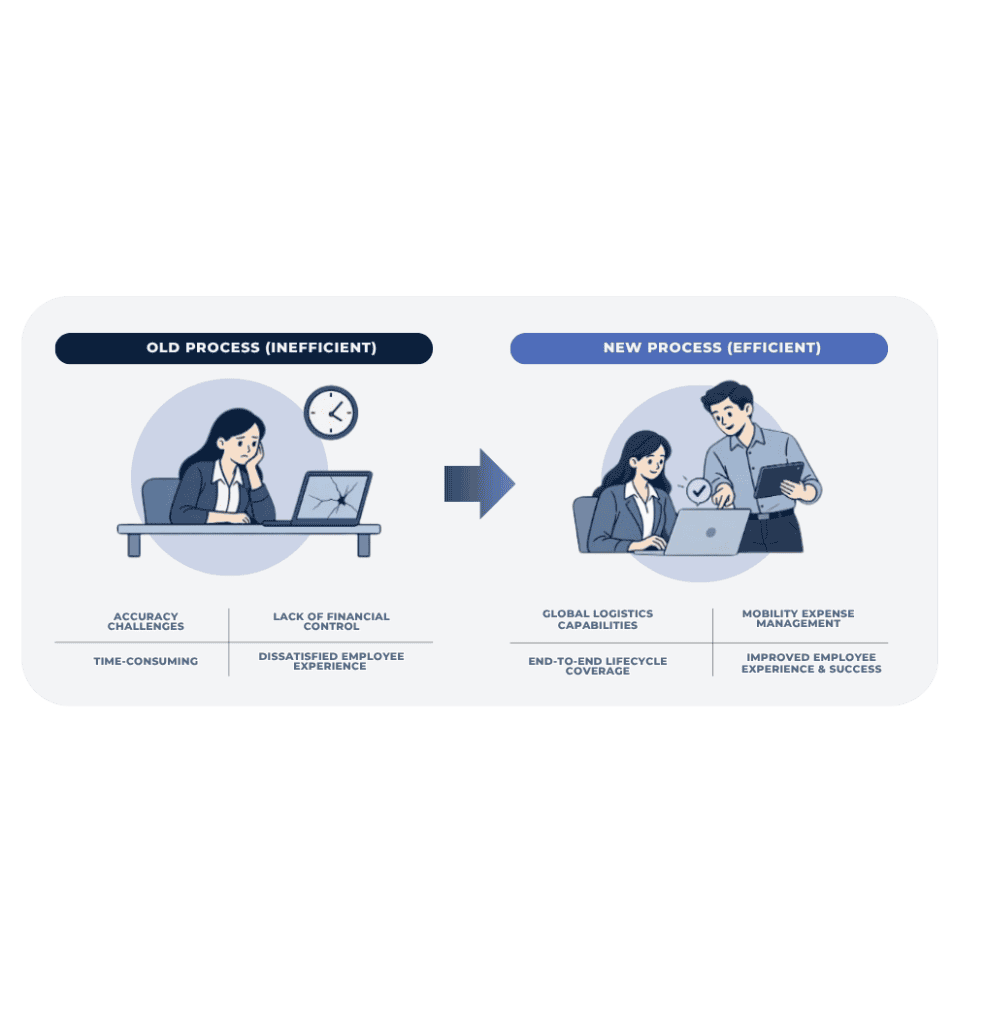
Managed mobility services can help organizations bring greater consistency to mobility operations while reducing the administrative burden associated with large device estates.
Reduce the operational burden on IT. Device procurement, repairs, and support consume significant internal resources. Mobile managed services can automate routine processes and provide specialized support for day-to-day administration, allowing internal teams to focus on higher-value technology priorities.
Maintain accurate mobility inventory. Reliable inventory gives organizations visibility into which devices exist, ownership, associated services, and where they sit in the lifecycle to support cross-departmental decision-making.
Strengthen governance. Consistent policies, approvals, decision rights, and lifecycle standards create a framework for managing devices across departments and regions. Governance becomes especially important as ownership models and global requirements expand.
Control mobility costs. Connecting device, user, service and expense information helps organizations identify unnecessary services, optimize wireless plans and prevent retired or recovered devices from continuing to generate avoidable costs.
Improve the employee experience. Efficient device support processes can reduce the time employees spend waiting for the technology they need to work.
When Should You Consider Managed Mobility Services?
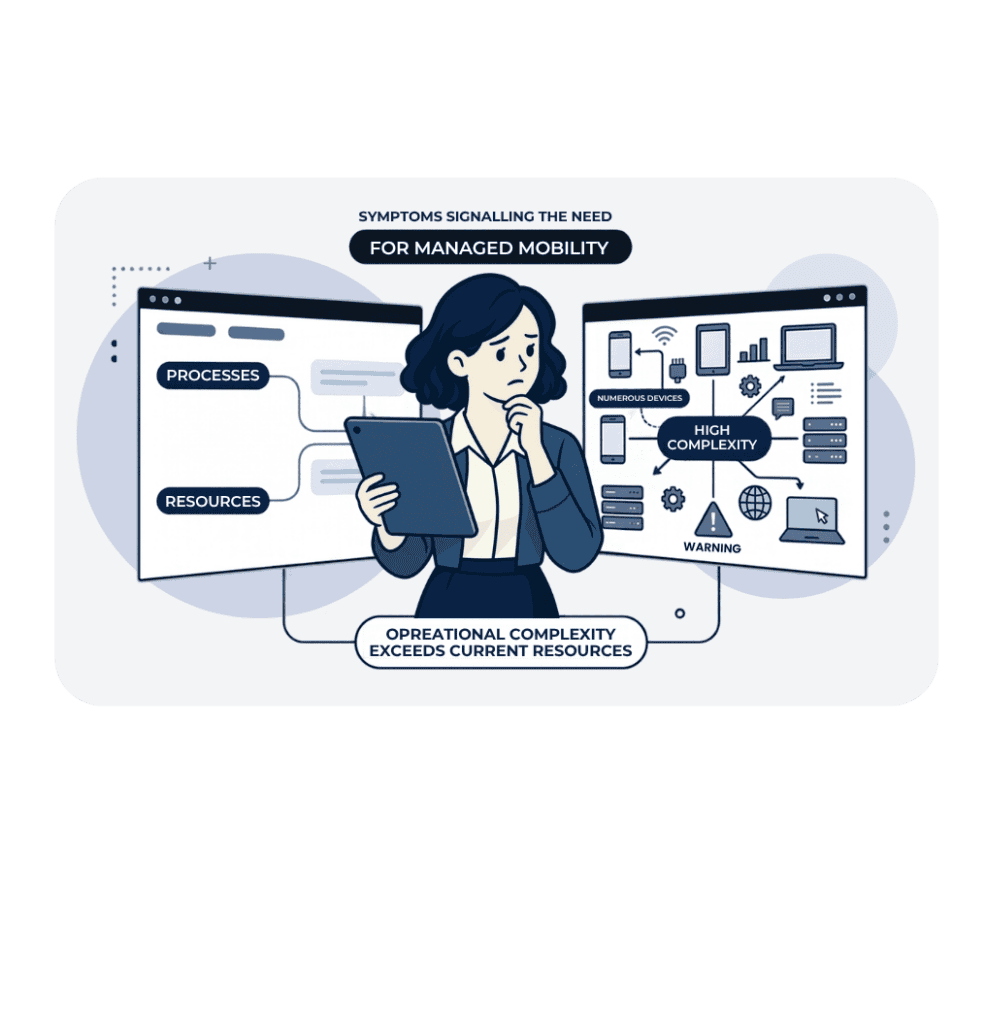
Managed mobility becomes particularly valuable when the operational complexity of an enterprise device estate begins to exceed the processes and resources used to manage it.
Symptoms in mobility estates that could signal it is time for managed mobility services include:
Manual, Time-Consuming Processes
One indicator is the amount of time internal IT teams spend coordinating devices, carriers, and vendors. When routine operations require substantial manual effort, mobility operations can pull resources away from more strategic initiatives.
Inventory Accuracy Challenges
Another signal is ongoing mobility inventory accuracy. Organizations may have device records across UEM, carrier portals, spreadsheets and procurement systems without a reliable view of device ownership, location or lifecycle status. Those gaps can make offboarding, upgrades, audits and expense optimization more difficult.
Dissatisfied Employee Experience
Long deployment times, inconsistent ordering processes and delays in replacing damaged equipment often indicate that mobility workflows vary across departments or regions
Budget Leak and Lack of Financial Control
Wireless expenses may be difficult to allocate, inactive devices can remain attached to paid services, and limited connections between inventory and billing make optimization harder.
Global Support Complexity
Global enterprises face additional complexity because logistics, carriers, device availability and support models vary across countries. A managed mobility model can create greater consistency while accounting for regional requirements.
Organizations experiencing several of these challenges may benefit from evaluating managed mobility services as a way to standardize operations, strengthen governance and reduce the manual effort required to manage mobility at scale.
What Should You Look for in a Managed Mobility Solution?
Choosing a managed mobility solution requires evaluating both technology and operational capabilities. Enterprise mobility spans multiple systems and business functions, so the solution should support the complete environment rather than create another isolated source of data.
End-to-end lifecycle coverage: Look for support across procurement, provisioning, deployment, active management, support, recovery and retirement. Maintaining continuity across these stages helps preserve inventory accuracy and reduce manual handoffs.
Global logistics capabilities: Distributed enterprises should evaluate whether a provider can coordinate device sourcing, configuration, shipping, recovery and support across the countries where employees operate.
Mobility expense management: A comprehensive solution should connect device and service information with wireless spend, enabling invoice validation, allocation, reporting and ongoing optimization.
Workflow automation: Business rules and automated workflows can reduce manual coordination while ensuring that lifecycle events follow established policies and approval requirements.
Enterprise integrations: Connections with UEM, ITSM, HR, ERP, procurement, carrier and logistics systems help keep device information aligned with the systems that drive lifecycle activity.
Inventory accuracy: The platform should maintain authoritative relationships between devices, users, locations, connectivity and lifecycle status as the environment changes.
Analytics and intelligence: Reporting and analytics should help teams understand inventory, service performance, costs and operational trends, while intelligence capabilities can surface exceptions and opportunities requiring attention.
Service expertise: Technology can automate significant portions of mobility management, although enterprise programs still require operational work. Evaluate the expertise and support available for logistics, carrier management, expense optimization, device support and other ongoing activities.
Scalability: A managed mobility solution should accommodate changes in device types, carriers, locations, countries and ownership models without requiring the organization to rebuild its operating processes each time the mobility estate evolves.
The strongest managed mobility solutions connect these capabilities so organizations can move from visibility into their mobility environment to consistent governance and effective operational control.
Ready to take control of your Managed Mobility Services?
Book a demo today and see how you can optimize your unified technology spend management.
Calero | Technology Business Management Solutions Optimize costs, inventory, and operations for SaaS, mobility, telecom, and beyond with a single unified technology business management platform.